

An executive statutory analysis of non-judicial remedies under Texas Property Code § 93.002, Forcible Detainer practice in Harris County Justice Courts, and high-stakes lease damage recovery in the Texas District Courts.
1. The Commercial vs. Residential Divide Under Texas Law
In Texas, commercial tenancies are fundamentally distinct from residential rentals. While residential tenants are backed by heavily codified public policy safety nets, commercial lease dynamics operate under the presumption that both parties are sophisticated business entities. Consequently, the language written within a commercial lease agreement heavily dictates the parameters of dispute resolution, lease enforcement, and possession recovery.
Why the Terms of the Written Lease Agreement Supersede the Texas Property Code
Texas courts consistently enforce a foundational principle: absent outright illegality, sophisticated commercial entities have the right to contract around statutory provisions. If a carefully drafted commercial lease agreement contains clauses that explicitly modify, expand, or waive standard statutory timelines, notice requirements, or landlord remedies, those contract terms will supersede the Texas Property Code. For a landlord’s trial counsel, evaluating the explicit terms of the lease is always the necessary first step before pursuing any enforcement mechanism.
2. Statutory Lockouts Under Texas Property Code § 93.002
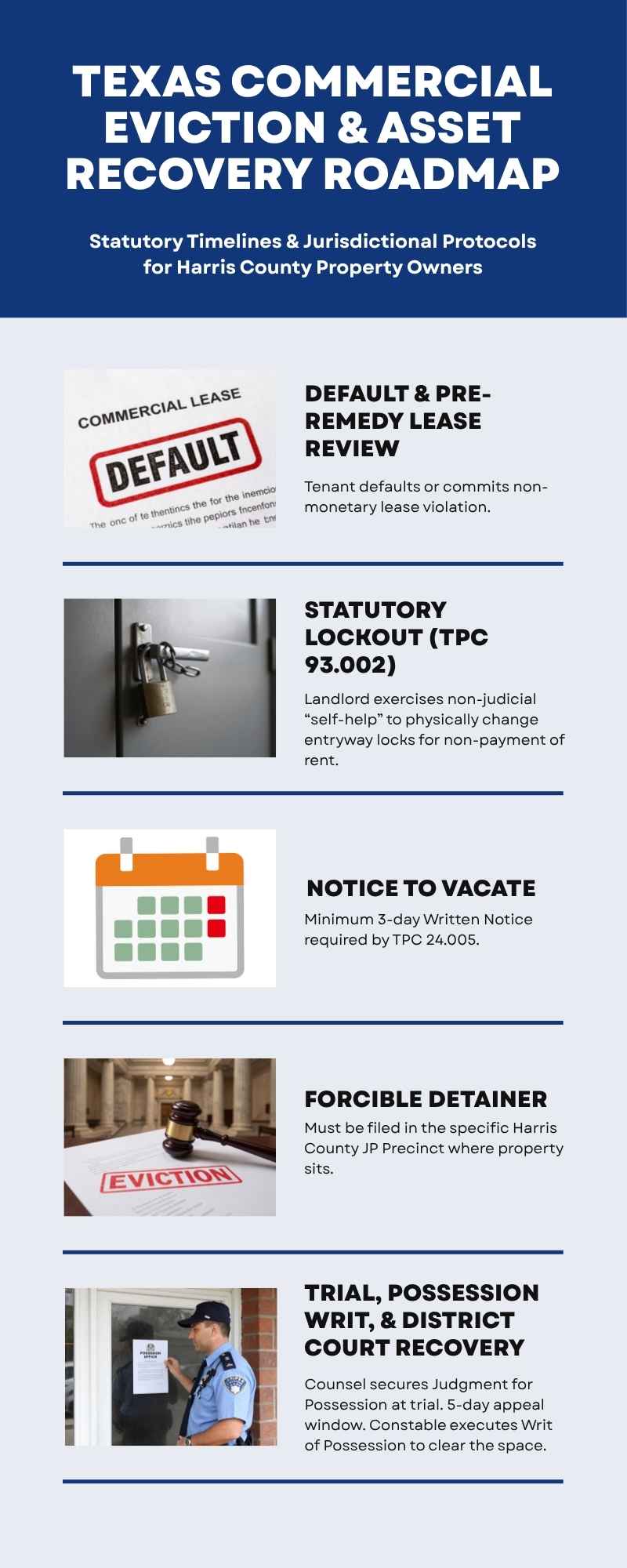
One of the most potent pre-litigation remedies available to a commercial landlord dealing with a non-paying tenant is the right to execute a non-judicial lockout. Governed by Texas Property Code (TPC) § 93.002, this allows a landlord to physically change the door locks on a commercial leasehold when a tenant is delinquent on paying any portion of the rent. Unlike the residential sector, where “self-help” lockouts face severe regulatory limits, a commercial landlord can move quickly to restrict access to the space, provided they strictly follow statutory parameters.
Strict Compliance with TPC § 93.002(f) Notice Protocols
A commercial lockout is a powerful enforcement tool, but it requires precise procedural execution. Under TPC § 93.002(f), simultaneously with changing the locks, the landlord must place a written notice on the tenant’s front door. This notice must state the name and the address or telephone number of the individual or management company from whom the new key may be obtained.
Crucially, the law mandates that the landlord is only required to provide the new key during the tenant’s regular business hours, and only if the tenant pays the full amount of the delinquent rent. This creates significant operational leverage, effectively preventing the tenant from accessing inventory, equipment, or office spaces until their financial default is cured.
Quick-Reference: Commercial vs. Residential Lockout Remedies
| Remedy Parameter | Commercial Tenancy (TPC Chapter 93) | Residential Tenancy (TPC Chapter 92) |
|---|---|---|
| Advanced Warning Notice | Not statutorily required. The lockout and front-door notice can occur simultaneously upon rent delinquency unless a lease clause dictates otherwise. | Strictly required 3 to 5 days in advance via certified mail or distinct hand-delivery parameters. |
| Condition for Releasing New Keys | The landlord is only obligated to release keys during regular business hours after the delinquent rent is paid in full. | The landlord must provide a key immediately upon request, regardless of whether the back rent has been paid. |
| Unlawful Interruption Liability | Failing to follow statutory steps exposes the landlord to civil penalties, possession recovery, an amount equal to the tenant’s actual damages, one month’s rent, or $500, whichever is greater, and attorney’s fees + court costs, less any delinquent rent. | Statutory violation affords the tenant possession recovery, or lease termination, and recover from the landlord a civil penalty of one month’s rent plus $1,000, actual damages, court costs, and reasonable attorney’s fees in an action to recover property damages, actual expenses, or civil penalties, less any delinquent rent or other sums for which the tenant is liable to the landlord. |
Risks of Material Breach: The Trap of Wrongful Commercial Lockouts
Because a lockout is a severe remedy, the margins for error are razor-thin. If a landlord lockouts a tenant based on flawed accounting, fails to post the door notice precisely when the locks are altered, or refuses to provide the key after a proper tender of back rent, the execution can backfire. A wrongful lockout can be construed as a material breach of the lease, legally absolving the tenant of future rent obligations and enabling them to sue the landlord for conversion of property, lost business profits, and attorney’s fees.
3. The Forcible Detainer Suit in Harris County Justice Courts
If a commercial tenant remains in default and refuses to vacate the premises after a lockout or lease termination, a landlord cannot simply seize the interior property or forcefully remove the occupants. To regain legal possession, the landlord must file a formal eviction action, known as a Forcible Detainer lawsuit, under Texas Property Code Chapter 24.
Drafting and Serving the Unequivocal Notice to Vacate
Before an eviction suit can be filed, the landlord must provide the tenant with a written Notice to Vacate. Under TPC § 24.005, unless the commercial lease sets a shorter or longer timeframe, the law requires a minimum of three days’ written notice. The notice must be unequivocal, demanding full possession of the property. It must be delivered via hand delivery, regular mail, or certified mail return receipt requested to the leased premises to satisfy jurisdictional prerequisites before a judge can hear the case.
By statute, Forcible Detainer suits fall within the exclusive jurisdiction of the Justice of the Peace (JP) Courts. The lawsuit must be filed in the specific precinct and place where the commercial property is physically located. For property owners across Greater Houston, this means identifying the exact boundaries of the Harris County JP system (e.g., filing in Precinct 1, Place 1 for downtown corporate properties, or Precinct 5 for spaces located along the Energy Corridor).
While the JP court has exclusive authority to determine who has the immediate right to physical possession, it is subject to a strict $20,000 statutory jurisdictional limit regarding claims for back rent. If the tenant’s unpaid rental arrears exceed $20,000—as is common in commercial real estate disputes—the property owner’s legal counsel must strategically evaluate whether to limit the JP suit strictly to possession and file a separate breach of lease suit in a higher court to recover the financial debt.
4. Beyond Eviction: Litigating Breach of Contract & Damage Recovery
Regaining control of the physical real estate is often only the first phase of commercial asset protection. When a business tenant defaults on a multi-year commercial lease agreement, the long-term financial damages to the landlord can be severe, encompassing unamortized tenant improvements, leasing commissions, and substantial outstanding rent balances.
Elevating High-Dollar Claims to Harris County District Courts
When commercial lease damages cross the $20,000 threshold, trial counsel will typically elevate the breach of contract litigation to the Harris County Civil District Courts. In these courts of general jurisdiction, a landlord can sue for the full scope of contractual damages. This includes invoking lease acceleration clauses to claim the remaining balance of the rent due through the end of the lease term, minus the property’s fair market rental value, alongside recovery for physical property destruction and comprehensive litigation expenses.
Enforcing Landlord’s Liens and Executing Distress Warrants
To ensure there are actual assets available to satisfy a future judgment, Texas law provides commercial landlords with a powerful security mechanism: the Statutory Landlord’s Lien under TPC Chapter 54. This lien automatically attaches to all non-exempt personal property, equipment, fixtures, and inventory owned by the tenant that reside inside the leased premises.
To prevent a defaulting tenant from secretly moving or liquidating these assets during pending litigation, a landlord’s attorney can apply for a Distress Warrant from the court. This extraordinary remedy authorizes law enforcement to seize and secure the tenant’s property inside the space, preserving those assets until a final foreclosure judgment can be obtained to offset the landlord’s financial losses.
5. Frequently Asked Questions: Commercial Evictions in Texas
Can a commercial landlord lock out a tenant if the lease doesn’t explicitly mention it?
Yes. In Texas, the right to execute a commercial lockout for non-payment of rent is a statutory baseline remedy provided under Texas Property Code § 93.002. However, if the written lease agreement contains terms that expressly forbid, restrict, or modify lockout procedures, the contractual language of the lease will control over the statute.
What happens if a commercial tenant appeals a Houston JP court eviction judgment?
Either party has a strict five-day window from the date of the judgment to file an appeal to the Harris County Civil Courts at Law. Filing an appeal triggers a trial de novo, meaning the case is transferred to a higher county court and heard completely fresh, bypassing the JP court’s findings and requiring strict compliance with formal Texas Rules of Civil Procedure and rules of evidence.
Can a landlord sue a corporate tenant’s owner individually for unpaid commercial rent?
Generally, corporate structures and LLCs shield individual owners from personal liability under the Texas Business Organizations Code. However, a landlord can pursue an individual owner directly if they executed a separate, personal guaranty agreement, or if the landlord’s counsel can demonstrate structural fraud, undercapitalization, or severe corporate alter-ego behaviors sufficient to pierce the corporate veil in a court of law.
Strategic Business Litigation & Dispute Resolution in Houston
When lease disputes escalate into costly standoffs, business and commercial property owners require decisive legal navigation. Watch this brief 30-second briefing by Walter Law Firm, PC, outlining our firm’s trial approach to business protection and commercial litigation in Harris County.


